



Designing the white space for flexible fibre requirements
The white space at the heart of a data centre is where the competing demands of rapidly increasing capacity within a finite space are in the sharpest focus. Kyle Russell, Sales Manager of Digital Solutions at Prysmian, examines the design issues around accommodating, routing and maintaining a reliable fibre infrastructure. (First published in Data Centre Dynamics, August 2026.)

Network capacity is increasing faster than the physical space available to deliver it. This is the central challenge facing the designers of data centre facilities. It’s a trend that is, of course, accelerated hugely by the growth of AI.
To put it simply, Graphics Processing Units (GPUs) are larger, consume more power and generate more heat than the CPU-centric architectures traditionally deployed in data centres. As AI workloads increase, racks that would have been planned around modest fibre counts now need to accommodate thousands of fibre connections per rack or cluster.
This is more than simply a question of finding the right accessories. Industry standards point to this issue as central to the design of a robust data centre environment. BS EN 50600-2-4:2023 includes pathway systems, spaces and enclosures within the scope of telecommunications infrastructure. The Telecommunications Industry Association (TIA), BICSI and ISO standards take the same view. The passive equipment is a fundamental design issue – not a fit-out detail.
The space pressure

Data cable has to share a finite space with power, cooling, containment and maintenance access. Managing cable routes, maintaining minimum bend radius and dealing with congestion at the rack and frame entry points are often the main constraints – rather than the capacity of the rack itself.
This is where reduced diameter cable becomes a significant asset. The ability to accommodate 864 fibres in a cable less than 10mm in diameter is valuable not because of the fibre count alone, but because it frees up space in highly congested environments.
Contributing to cooling
Cooling is another huge issue. Data centres traditionally used a raised access floor design with the void under the floor used for both cool air delivery and cable routing. Over time, as obsolete cable is almost never removed, the build-up of cable in the cooling space became a significant issue, obstructing the cooling function. This is highlighted by ASHRAE in its design guidance, which explicitly recommends using overhead ducting to route cable.
Densification has moved the dial as operators are increasingly using direct-to-chip cooling rather than relying on air circulation. Rear door heat exchangers are also an important part of the cooling process, so cabinet design has had to change entirely. Cable access is now at the sides, keeping the front and rear faces clear for passive cooling. This approach can significantly reduce the amount of heat released into the room environment, potentially reducing reliance on traditional hot aisle containment strategies - depending on the overall facility design.
In high density environments, therefore, cable management plays an important role in thermal management.
Ducting, raceway and bend radius
Every point at which a fibre changes direction, enters a frame or drops into a cabinet is a place where a minimum bend radius needs to be accommodated. It cannot be assumed, it must be designed into a raceway infrastructure using purpose-designed ducting and raceway.
Ducting will provide the physical protection required for the cable, but it is the raceway that will ensure the route taken by the cable accommodates its minimum bend radius effectively. So a route dropping into a cabinet, for example, provides a moulded radius rather than simply dropping the cable off the edge of a tray.
Bend insensitive fibre provides greater routing flexibility while still requiring compliance with the manufacturer’s specified minimum bend radius. The raceway needs to be designed to work with the bend characteristics of the specific cable, so the two product areas need to be part of the same specification.
The contribution of the ODF
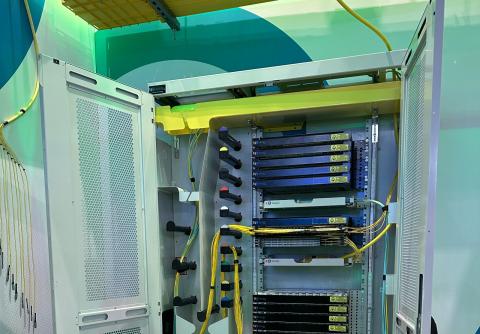
An Optical Distribution Frame is about much more than simply accommodating fibre. A frame can carry an impressive quantity of connections but still be a poor design if a technician cannot inspect, clean and patch an individual circuit without disturbing the connections around it.
A well designed ODF fulfils a number of different functions. Bend radius has to be accommodated inside the enclosure on both the trunk and the patch cord sides. Slack has to be stored and patch routing should be defined. It’s not good enough for a technician to be making subjective decisions about the routing or labelling of a cable – the ODF should direct the cable route and allow for labelling to be both durable and easy to access and update.
Our own ODF design was optimised around high-density cabling and is deliberately cable-agnostic, with density optimised for the cable actually being used in any given installation. This is an essential design feature for ODFs as facilities are rarely single-sourced and the passive infrastructure need to be able to accommodate changes in cable choice as replacements are made over time.
Making change safe
Environments handling very dense cabling infrastructure do not accommodate improvisation. A single change in a congested frame has the potential to disturb adjacent connections, breach a bend radius or end up with the cable in the wrong port. One solution to this challenge is a modular structured cabling system that is repeatable and easy to identify, making replacement of individual components less likely to cause unexpected consequences.
The same logic applies to the build programme. Operators increasingly ask for the passive infrastructure to be installed and tested before the live equipment arrives, moving termination and testing off-site. Pre-terminated assemblies reduce the requirement for skilled work to happen on site in cramped and live white space, reducing the potential for variations in quality of installation.
Fibre densities will continue to rise as AI and high-performance computing drive demand for greater connectivity. While active equipment attracts much of the attention, the long-term success of a facility often depends on the passive infrastructure that supports it. Designing cable, containment and fibre management as a single integrated system is increasingly becoming a prerequisite for delivering scalable, resilient and operationally efficient data centres.