


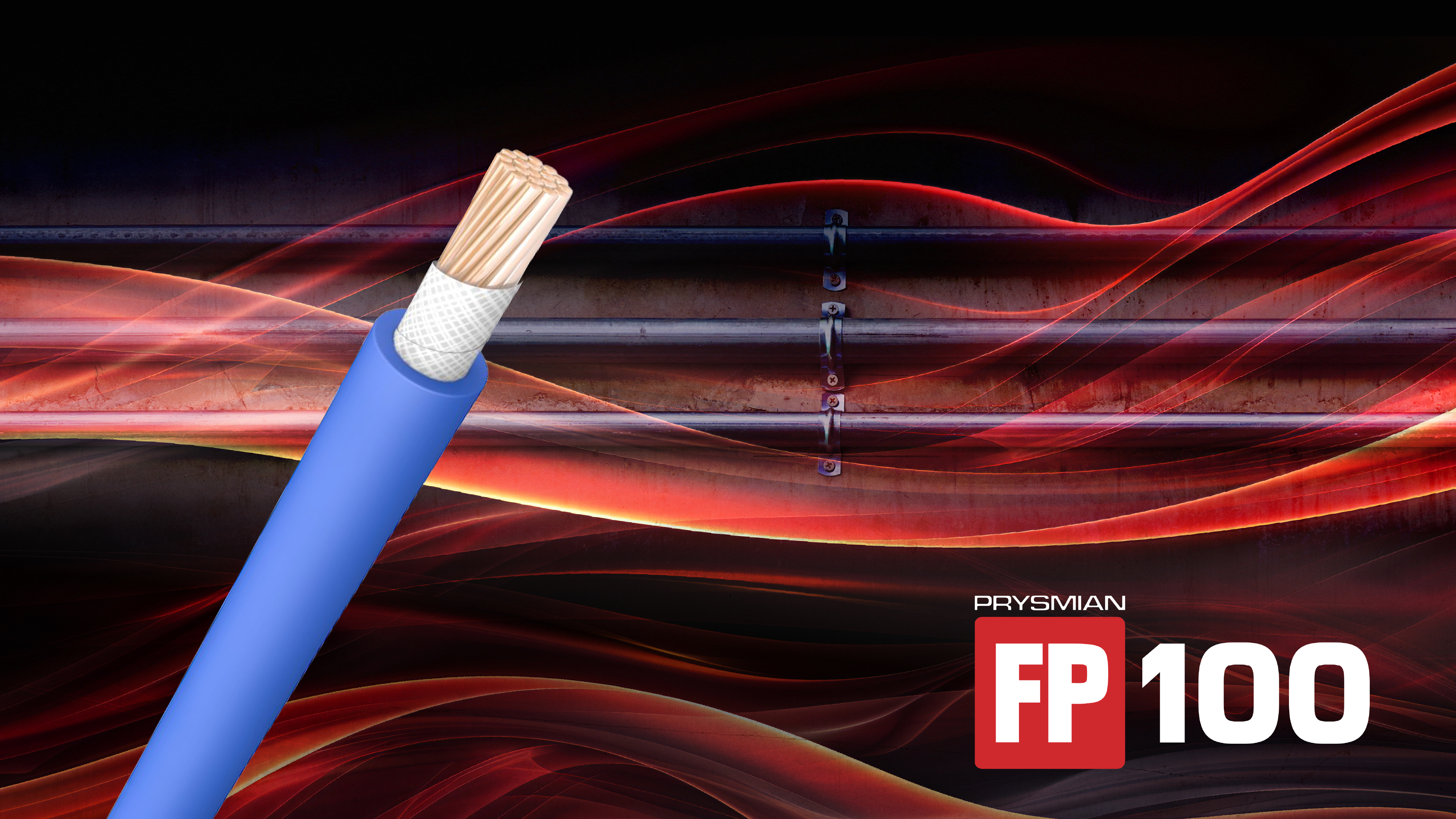
A specifier’s guide to FP100
For fire-fighters to safely access and tackle a fire in a building, there needs to be a fire-fighting shaft. These areas often incorporate a stairwell and fire-fighting lobby and must be illuminated, accessible and monitored in the event of a fire to allow fire-fighters to work effectively and safely. Designers typically classify, normal lighting and monitoring systems in fire-fighting shafts as life-safety installations, forming a crucial part of the building’s fire-safety strategy.
What cables are required for fire-fighting shafts?
In accordance with BS 8519:2020, "fire-fighting shaft normal lighting” and “fire-fighting shaft monitoring systems” both require fire resistant Category 3 control cables as set out in section 5, Table 1, “Recommended cable categories based on application”. That means that these systems must continue to operate in the event of a fire for longer than straightforward evacuation systems and require cables with suitable mechanical protection to maintain circuit integrity and of course, provide low smoke emission.
In applications such as these, Prysmian FP100 cable installed in screwed steel conduit, provides an ideal solution.
Meeting the standards: BS 8592
BS 8592:2016 refers to thermosetting insulated, non-armoured, fire resistant, single core cables of rated voltage 450/750 V, having low emission of smoke and corrosive gases when affected by fire. This particular standard details the construction specification of small-sized, single core cables.
Prior to 2016, there was no BS manufacturing specification for these types of cables. “BS 8592 addresses a market need to standardize non-armoured, single core non-sheathed cables as a result of the proliferation of designs and requirements in the market.” In short, the standard provides specifiers with a clearer benchmark for performance and safety.
A spotlight on FP100
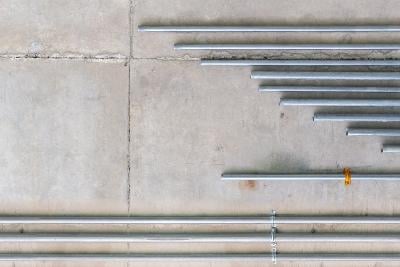
Prysmian FP100 is a fire-resistant low voltage, single core cable designed for use in screwed steel conduit. FP100 is ideal for drawing into conduit installations that provide adequate mechanical protection and forms the key part of a wiring system for evacuation and fire-fighting applications. It’s worth mentioning that the more commonplace FP cables, such as FP200 Gold and FP PLUS are almost always easier to install, bend and do not require conduit.
It’s also worth noting that listed or architecturally restrictive buildings may feature large swathes of shutter-cast concrete where the client will not allow any cutting into the surface to bury normal cables but might allow screwed steel conduit on the surface. In a retrofit listed building, cutting into the surface should be avoided at all costs.
FP100 meets the requirements set out in BS 8592, demonstrating compliance with the standardised specification for small, fire-resistant single-core cables.
The cable is also tested to IEC 60331-3:2018, which “specifies the test method for cables which are required to maintain circuit integrity when tested in a metal enclosure and when subject to fire and mechanical shock under specified conditions.” The tests are applicable to cables of rated voltage up to and including 600 V to 1000 V.
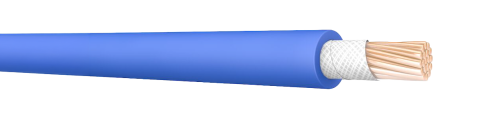
Featuring a stranded, bare copper conductor and a mica/polymer fire resistant insulation composite with 90°C cross-linked rating, FP100 provides robust fire performance. The cable’s LSOH insulation package meets the requirements set out in BS EN 61034-2 for smoke emission and BS EN 60754-1 for corrosive and acid gas, delivering low smoke, non-corrosive emissions during fire events.
FP100 is rare in UK construction, but is regularly the choice of designers for the most stringent fire regulations and fire-fighting shaft lighting,
Cost and Expectations
Whilst FP100 may appear straightforward due to its compact size, this can hide the reality of what compliance requires in fire-fighting shafts. FP100 must not be used as a stand-alone product; it must form part of a complete, compliant wiring system. This includes screwed steel conduit, the necessary materials, appropriate supports and fixings, and the additional installation time associated with that system.
That means, that once all the requirements are considered, FP100 with its conduit and associated supports, does not result in a cheaper installation compared to other compliant solutions. In some installations, however, it remains the best solution.
The screwed steel conduit is an essential part of the system to deliver mechanical protection, fire performance, and compliance with BS 8519 and BS 8592. Not using a screwed steel conduit leaves the system at risk and may fail to meet the regulatory requirements
A specialist cable
In summary, Prysmian FP100 is a highly specialised cable that plays a specific role within fire-resistant cable systems. When installed in screwed steel conduit, FP100 provides a fully compliant cable solution for fire-fighting shafts where lighting and monitoring systems are integral to the building’s fire strategy. Understanding the application and installation requirements of FP100 helps ensure compliance with BS 8519 and BS 8592 and manage costs.
Learn more about Prysmian FP100 or download the datasheet. If you need further advice on FP cables, get in touch.