


Technical Developments in Optical Fibre
Ian Griffiths, Global R&D VP at Prysmian considers how current and future advances in technology shape the future of optical fibre applications in data centre environments. (First published in Data Centre Dynamics May 2026.)

The development of optical fibre was arguably the single most significant enabler of digital communication. It has revolutionized telecommunications by enabling high-speed, long-distance data transmission with immense bandwidth, far surpassing the capabilities of traditional copper wires. It has enabled long distance communication, Fibre-to-the-Home (FTTH) services, high-speed internet, on-demand video streaming, and online gaming. It is fundamental to the performance of any data centre.
Over the last twenty years the increasing transmission speed of optical fibre has been transformational, evolving from megabits per second (Mbps) in early systems to hundreds of terabits per second (Tbps) in modern, experimental, and high-end commercial applications.
So how has this happened and what is next on the horizon for the future development of optical fibre?
Glass Quality

Optical fibres are drawn from a glass rod (or preform) and its quality dictates the performance of the fibres. Modern fibres are very pure and use high-purity silica glass as their base material. Silica is chosen for its exceptional optical clarity, allowing light to travel over long distances with minimal attenuation (loss).
Advancements in the quality of the glass and the manufacturing processes used have enabled the development of Ultra Low Loss Fibres which are crucial today for long-haul, submarine, and high-capacity data centre networks, allowing for longer distances between amplifiers or regenerators.
Bend Insensitive Fibres
The development of bend-insensitive optical fibres has allowed cables to maintain performance even with tight bends. This innovation has enabled increased fibre density, and drastically reduced signal loss in high-density environments.
It helped to accelerate Fibre-to-the-Home (FTTH) deployments to provide easier routing of cables around corners and through narrow conduits in residential and commercial buildings without causing signal attenuation. By reducing susceptibility to macro and micro bending, it has enabled the use of smaller cables and supported higher fibre counts by allowing greater packing density of the optical fibres within a cable. This too has led to smaller connectivity providing greater port density in racks and patch panels.
Its superior robustness significantly decreased the need for repair and replacement caused by low quality installation, leading to reduced service calls and improved network lifespan, providing lower operating expenses (OPEX) for service providers.
Reduced Diameter Fibres
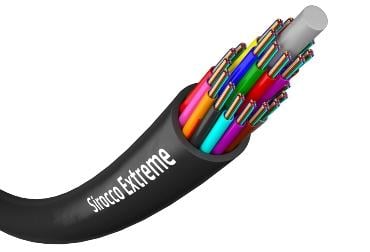
More recent optical fibre innovations have been focused on densification. The drive from the market for new optical cable solutions that are smaller, easier to handle and faster to install has led to a push for the miniaturisation of optical fibres.
When it comes to cable, size matters. The larger the cable, the higher the cost in terms of materials and in particular the space needed to install it. Operators need to squeeze every available millimetre of duct space and seek cabling solutions that offer the maximum fibre counts possible to fit into their already congested ducts.
Prior to 2010 optical fibre was standardized at 250µm in diameter. Then the first 200µm fibres were developed and deployed, keeping the same cladding diameter (125µm) to provide full compatibility between the two sizes in terms of splicing. For long distance and metro networks, and in particular data centre inter-connect, 200µm fibres have now become the standard of choice. More recent developments have seen the introduction of 180µm fibre in 2020 and 160µm in 2025. These advancements have enabled cable densities to exceed 10 fibres per square millimetre, which provides fibre counts of 864 to be offered in a cable of less than 10mm in diameter.
Building future capacity

Is this optical fibre technology future proof? For the fibre already deployed the answer is probably yes, but what about for the future densification of optical cables? Driven by the explosive demand for data capacity, largely powered by AI, hyperscale data centres, and the shift towards 6G, new innovations in fibre technology are required to increase speed, lower latency, and provide more capacity in the same space.
To address the capacity issue, Space Division Multiplexing (SDM) is an attractive option. This is a technique that increases data transmission capacity by using multiple parallel spatial channels, such as multiple cores, or modes within a single fibre.
Multi-Core Fibre (MCF) is one such development that can transform optical fibre densification by embedding multiple cores into a single fibre strand. Currently an optical fibre has a 125µm cladding diameter with one core of approximately 9µm in diameter in the centre. Placing four or more of these 9µm cores inside the same cladding diameter allows for vastly increased data capacity while keeping the cable diameters small.
On a particle level this means for the same physical space that one might deploy a cable with 864 fibres today, soon 3456 or more transmission channels can be accommodated. This is of particular interest for applications such as data centre interconnects, submarine cabling (due to space constraints), and high-capacity long-haul networks.
To increase speeds and lower latency the next big technical leap is on the horizon, with the development of Hollow Core Fibre (HCF). Hollow Core Fibre has an air core, and as light travels faster in air than it does in glass, it offers approximately 30% lower latency and reduced signal loss, enabling data to travel at 99.9% the speed of light.
This is particularly beneficial for future-focused AI data centre interconnects, high frequency trading, and long-haul networks. On a practical level, this technology is of particular interest to data centre operators as it can help reduce the cost of location. The extended reach of hollow core fibre can enable data centres to be spaced further away from each other where access to alternative power supplies and cheaper land is available.