


Optical Distribution Frame: Purpose, types and applications explained
With digitalisation rising significantly, the demand for reliable high-capacity fibre networks becomes increasingly valuable. This is where optical distribution frames (ODFs) can help.
ODFs play a crucial role, organising and managing fibre optic networks to ensure high-speed, stable connections. These components maintain network performance, simplify maintenance, and support scalable growth in increasingly high-density fibre environments.
What is an optical distribution frame?
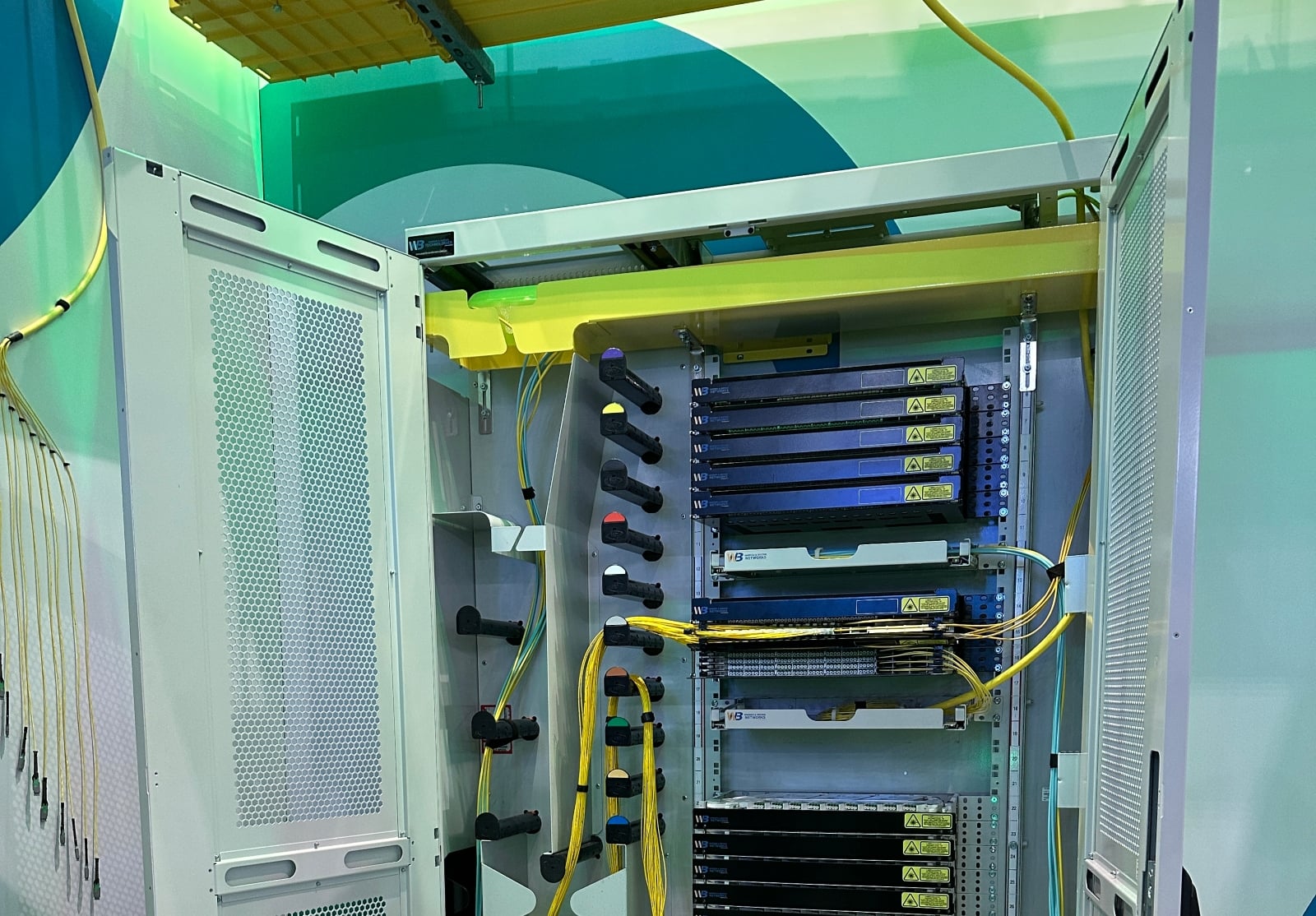
An optical distribution frame is a specially designed enclosure used to manage, organise, connect and protect fibre optic cables. ODFs are typically installed in data centres, telecommunication hubs and central offices.
The key function of an ODF is to consolidate fibre cable management and simplify signal routing, reducing clutter in high-density environments. It also allows technicians to easily access and test fibre ports and reconfigure fibre links quickly when needed. Another feature of ODFs is that they protect fibre connectors and pigtails from accidental damage.
Types of optical distribution frames
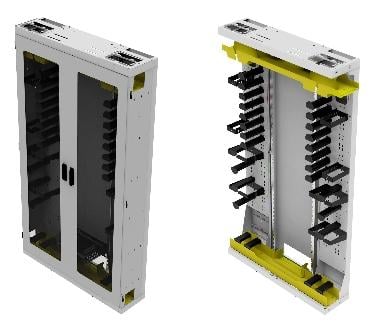
There are typically four types of optical distribution frames:
Rack mounted
Wall mounted
Floor mounted
Outdoor/weatherproof
Rack mounted
Rack mounted ODFs are often used in high-density environments such as data centres and comms rooms. They can hold up to 144 cores or more within standard server racks (19-inch, 21-inch or 23-inch). Some of the main advantages include:
Maximising fibre space – vertical rack space allows for high-density fibre management in areas with limited space.
Modular design – technicians can add new fibre modules without disrupting existing connectors. That means they provide flexibility for future demands.
Excellent cable management – racks incorporate features such as dedicated routing paths and strain relief clamps which reduces clutter and ensures signal integrity.
Rack mounted ODFs, however, demand dedicated space, which may be a challenge small-scale applications or rooms with limited space. Additionally, the component often comes with a high initial cost.
Wall mounted
A wall mounted ODF is a compact enclosure that is designed to be fixed directly onto a wall. It serves as a central distribution point in small networks and can be an alternative to large racks. They have several benefits:
Space-saving – they are smaller than standard racks, making them ideal for locations with limited space such as small offices and utility rooms.
Easy installation – generally designed for quick setup, they are lightweight, compact, and sometimes pre-terminated to allow for quick and easy installation.
Cost-effective – initial costs are lower compared to large racks or floor units, making them ideal for smaller projects such as low-density or fibre-to-the-home (FTTH) deployments.
Wall mounted ODFs, however, cannot scale easily to accommodate additional fibres because of their limited space. Also, expanding, replacing or reconfiguring the setup can be a challenge. Its fixed installation means it’s difficult to access and upgrade.
Floor mounted
Floor mounted ODFs are free-standing, sometimes closed cabinets designed to handle large volumes of fibre optic cables in data centres and telecommunication hubs. So, what makes them ideal for these applications?
Superior high fibre capacity. They can manage hundreds or even thousands of fibres in a single frame.
Robust protection. They are often closed structures, offering excellent protection against environmental factors and mechanical damage.
Large-scale fibre management. They allow for the termination of trunk cables, splicing and handling patching in one structured location.
However, floor units require a significant amount of dedicated floor space, and they are less flexible when it comes to making quick reconfigurations. They are more suited for long-term installations rather than frequently changing network infrastructures.
Outdoor/weatherproof
An outdoor or weatherproof ODF is a specialised, ruggedised enclosure that is designed for harsh external environments. It’s water resistant, dust-proof and provides temperature-controlled protection for fibre-to-the-antenna (FTTA) and street-side cabinets.
In the UK, outdoor units are often specified as IP65–IP67 depending on the deployment environment; IP67 indicates total dust protection and resistance to temporary immersion in water.
Standard wall mounted or pole mounted units for FTTx applications commonly support around 48–288 fibres, depending on the enclosure design. In larger rack/frame configurations, ODF systems can handle 1,000+ fibres.
Where optical distribution frames are used
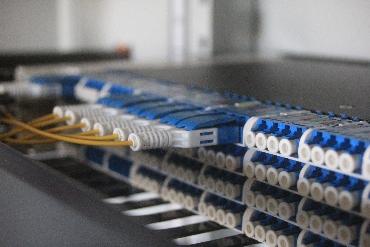
ODFs can be used in various applications, including data centres, telecom networks and FTTH.
Data centres
Optical distribution frames play a significant part in data centres, providing high-density, scalable connections for servers, switches and Storage Area Networks (SANs). They are essential in protecting, organising, and managing a significant amount of fibre cables. ODFS are located in a Meet-Me-Room (MMR) within a DC.
Telecom networks
ODFs provide organised cable routing, which is crucial in telecommunication networks, particularly for FTTH, 5G or other high-density connections. Organised cabling improves reliability and scalability of the networks.
FTTH
Small-scale ODFs provide efficient fibre cable management for fibre-to-the-home (FTTH) and fibre-to-the-x (FTTX) applications. They are used in optical distribution cabinets at access points to connect splitters and customer cables.
How to choose the right optical distribution frame
When it comes to specifying the right optical distribution frame, it’s essential to consider the application, technical requirements, environment, and long-term network strategy. Prysmian provides a wide range of solutions designed for exchanges, central hubs, offices and data centres, including the HD ODF, which features integrated cable management and capacity for over 5000 fibres, including 19-inch mounting rails and easy to use patch cord storage and routing systems. Installing the right ODF solution can help improve efficiency and ensures the network can scale reliably for evolving needs.